Small-Space Fall Gardening: One Raised Bed Layout for More Fall Vegetables
Last Updated: September 11, 2026 by Vegega Team
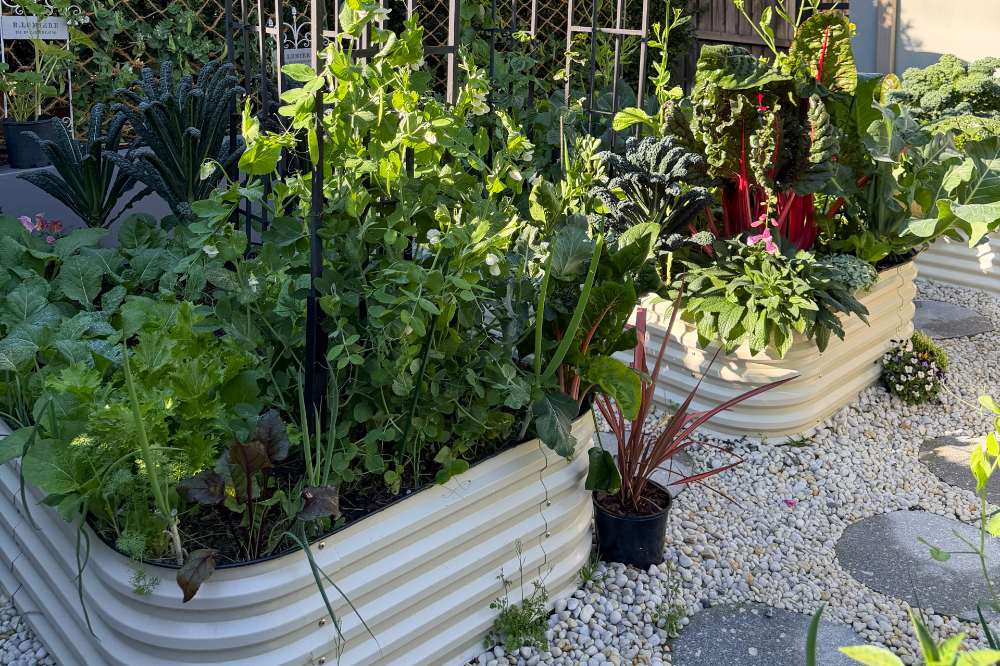
You don't need a large garden to grow a productive fall harvest. One well-planned raised bed can grow a surprising variety of fall vegetables when you choose compact crops, use vertical and square-foot planting, and place plants according to their height and mature size. The key is not simply planting more—it is using every part of one raised bed intentionally.
- Why One Metal Raised Bed Is Enough to Start a Fall Garden
- Choose Compact Fall Crops That Give You More Harvest in Less Space
- How to Plan a Small-Space Fall Garden in One Raised Bed
- Refresh the Soil and Protect the Bed for a Longer Fall Harvest
For people with a small courtyard, terrace, corner of a courtyard, or even just a small patch of open space, growing vegetables in the fall does not require a large garden. What really restricts the harvest is often not the space itself, but whether the limited space is planned well.
A metal raised garden bed is enough to become a practical small fall garden. Instead of placing multiple flowerpots and planting boxes in a limited area, it is better to first determine a raised bed that suits your space and then arrange the planting area according to the plants' mature size, height, and harvest time. In this way, the same piece of land can accommodate different types of vegetables at the same time, and it can also leave room for subsequent successful planting.
For small-space gardening, fall is especially suitable for this method. Many fall vegetables have a short growing period, are resistant to cold, and do not need to occupy a lot of horizontal space like large crops such as pumpkins and corn. By choosing compact crops and making use of every square foot of the raised bed, you don't need to expand your garden footprint to make a raised bed produce more fall harvests.
Next, let's look at how to divide the metal raised garden beds into small areas and arrange the planting density according to the space requirements of different crops after maturity to increase the yield per unit area.
Why One Metal Raised Bed Is Enough to Start a Fall Garden

For small space gardening, the space shape is often as important as the area. A raised bed with clear boundaries and fixed dimensions can make it easier to determine which areas are used for planting and which need to be set aside for pathways or working space. It is also more convenient to arrange different planting areas according to the mature size of the plants. This is one of the reasons why metal raised beds are suitable for small spaces. Compared with irregular ground planting areas, regular raised beds are easier to avoid the formation of stagnant water due to the closure of the container's bottom layout. Modular design allows you to choose the right size according to the backyard, patio, side yard, or other limited space, without having to re-plan the entire yard for a garden bed. For people who try fall gardening for the first time, using raised beds is easier to control. You can make good use of the limited space first and then decide whether to add more raised beds based on the planting needs of the next season.
Secondly, metal raised beds are good for a long-term small garden. Metal raised beds are not as easy to rot, even under long-term exposure to soil and moisture, compared with unprotected wooden materials. For those who want to maintain the garden structure in multiple planting seasons, the durable metal structure means that there is no need to frequently replace the entire planting area due to the aging of the bed itself. VEGEGA uses Zn-Al-Mg-coated steel to enhance structural stability. For small-space gardeners, this kind of durability is particularly valuable: when the garden area is already limited, a raised bed that can be used for a long time can continue to undertake planting tasks in different seasons without the need to re-establish a new growing space every year.
In addition, metal raised beds let the soil drain naturally. VEGEGA metal raised beds feature an open-bottom design, allowing for natural drainage (read more about do metal raised garden beds need a bottom). Water can be discharged downwards and connect to the soil environment below, which helps to avoid the formation of stagnant water due to the closure of the bottom of the container. This is especially important for fall planting. As rainfall increases, if the planting area is poorly drained, long-term soil moisture If the planting area has poor drainage, increased rainfall can lead to long-term soil moisture that affects the root system's condition. the state of the root system. Therefore, when establishing a raised bed in a limited space, in addition to considering how much can be planted, it is also necessary to consider whether the soil can maintain appropriate moisture and drainage conditions.
Choose Compact Fall Crops That Give You More Harvest in Less Space


When you have only one raised bed, the choice of crops can't just depend on whether they can be planted in the fall, but also on whether they're worth taking up limited growing space. Preference is given to crops that grow faster, are cool-tolerant, have relatively compact plant types, and can be harvested continuously or sown repeatedly, allowing the same bed to produce more harvests in the limited fall. When choosing small-space fall crops, the following types of crops are particularly worthy of priority.
Leafy Greens: High Yield Without Taking Up Much Space
Leafy greens are a practical type of crop in a small fall garden. Spinach, arugula, lettuce, and kale are all more suitable for the cool season, and compared to many fruits and vegetables that take up space for a long time, they usually do not require a lot of horizontal space. Another advantage is their harvest pattern. Lettuce, arugula, and spinach can be picked by the outer leaves as needed, or planted in batches, allowing different areas to enter the harvest window at different times. In this way, a raised bed does not need to be full of mature plants at once, and it can continue to provide fresh greens.
If planting space is limited, leafy greens are also suitable as one of the main crops because they can fill smaller planting areas in the raised bed without quickly squeezing the surrounding plants.
Root Crops: Make Use of the Space Below the Soil
The advantage of radishes, carrots, and beets is that they mainly use the growing space under the soil. This is important for square-foot gardening. Unlike plants that need to spread out, root crops can form the main harvest part below the ground, so they can share the same raised bed with other plants without relying entirely on horizontal space.
Among them, radishes are especially suitable for compact gardens in autumn. They usually grow faster and can be harvested in a relatively short time. After the first batch of radishes is harvested, they can also be resown to allow the same area to continue to function. However, root crops do not mean that they can be densely planted indefinitely. The final root size still determines the required spacing, so arrangements should be made according to the mature size of the specific variety and the recommended spacing on the seed packaging.
Compact Herbs: Small Footprint, Long Harvest Window
If the raised bed has some scattered space after arranging the crops, cilantro, parsley, and green onions are also good choices. These herbs usually do not need to occupy a large planting area but can continue to provide a harvest. Especially in a raised bed dominated by fall vegetables, they can take advantage of some smaller planting sections without having to set up a garden bed for herbs separately. For a real mini garden, this kind of small-area, continuous-use crop is valuable. They may not bring the largest single harvest, but they can improve the overall utilization rate of the entire bed.
Cool-Season Vegetables: Choose Smaller Varieties When Space Is Tight
In addition to leafy greens and root crops, some cool-season vegetables can also be added to a small fall garden, such as bok choy and some compact brassicas. Such crops can provide a richer fall harvest than simply planting greens. But not all vegetables are suitable for small-space gardening. For example, although broccoli, cauliflower, and cabbage are typical cool-season vegetables, they usually require more space when they mature. If the raised bed area is limited, priority can be given to varieties with more compact plant types.
How to Plan a Small Space Fall Garden in One Raised Bed

Arrange Plants by Height and Sunlight
In most parts of the United States, the sun runs in the southern sky, so if tall plants are placed on the north side of low plants, they are usually less likely to block the sunlight from the crops in front of them for a long time. Therefore, if the raised bed is placed in an east-west direction, tall plants can be arranged on the north side, which is the back side of the bed; medium-height plants are placed in the middle, and the shortest leafy greens, herbs, etc. are placed on the south side or the leading edge.
If the raised bed is placed in a north-south direction, the situation will be slightly more complicated. The sun moves from east to west, and the shadows produced by plants change with the time of day. At this time, in addition to considering the north side principle, you can also combine the west-to-east height arrangement to manage the strong light in the afternoon. In areas where it is particularly hot and the westward sun is obvious in the afternoon, some taller plants or a trellis can be placed on the west side to allow them to form a certain shade in the afternoon. While leafy greens, which are more afraid of heat, can be arranged in a relatively protected position. However, the point here is not to mechanically follow the west high and east low, but to observe your actual lighting conditions. Tall plants should try to avoid blocking the most important sunlight for low-growing crops, and at the same time, local shade can be used to help some autumn vegetables that are afraid of heat spend the still-hot afternoon.
Use Every Layer of the Raised Bed
A raised bed can actually take advantage of growing space in three directions at the same time. Horizontal space: divide planting sections on the bed, such as square-foot gardening. Vertical space: use a trellis to grow beans, peas, or climbing crops, allowing some plants to grow upwards instead of occupying the ground all the time. Below-ground space: use radishes, carrots, beets, and other root crops to use the space under the soil. This is why planting more does not mean planting plants more densely. The truly effective layout is to allow different plants to use different spatial levels as much as possible, reducing competition between them for the same horizontal space.
Leave Room for the Next Harvest
Don't waste every piece of soil in the raised bed and fill every gap immediately. In the fall garden, setting aside a portion of the space that can be reused is an efficient layout in itself. For example, after a batch of radishes is harvested, it can be re-sown immediately. After the early lettuce or greens are over, this area can also be handed over to the next crop. Therefore, when planning a raised bed, one part of the space can be regarded as the current planting space and the other part as the future planting space. In the end, a good small-space fall garden layout is not to fill every square foot with plants on the first day, but to make every square foot have a clear purpose. Some use sunlight, some grow upward, some use underground space, and some wait for the next round of sowing.
Refresh the Soil and Protect the Bed for a Longer Fall Harvest
Once your fall garden is planned, the next step is to keep the same growing space productive as the season progresses. Succession planting makes this easier. After harvesting an early crop such as lettuce or radishes, remove the spent plants, refresh the soil with compost or other organic matter if needed, and replant the space with another quick-growing crop. This allows one raised bed to support more than one harvest without needing additional garden space.
As temperatures drop, protecting the plants becomes just as important as planning the layout. Row covers or raised bed covers can help protect fall crops from unexpected frost, wind, and colder nights while extending the usable growing season. For a small garden, covering the entire raised bed can also be more practical than protecting individual plants.
With the right crop choices, efficient layout, and simple seasonal maintenance, one well-planned raised bed can keep producing from the first fall planting through multiple harvests.
Conclusion
A small garden doesn't have to mean a small harvest. With one well-planned raised bed, you can create a productive fall garden without expanding your garden footprint. The key is to choose compact, cold-tolerant crops that make good use of limited space, then organize them by height and growth habit. Place taller plants toward the back, medium-height crops in the middle, low-growing vegetables and herbs along the front or edges, and use open spaces for root crops. For smaller beds, square-foot gardening and vertical planting can help you make even better use of the space.