How Much Space Do Plants Need - A Raised Bed Plant Spacing Guide
Last Updated: August 6, 2026 by Vegega Team
Hot composting uses active microbial activity to create higher temperatures, speeding up decomposition and producing usable compost in a shorter time. Cold composting relies on slower natural decomposition, requiring less effort but taking much longer to finish.
- Why Plant Spacing Matters in Raised Bed Gardens
- How Much Space Do Common Vegetables Need?
- How Many Plants Can Fit in a Raised Bed?
- Common Plant Spacing Mistakes to Avoid
After building a raised bed, you will encounter a seemingly simple but actually important question: “How far should my plants be planted?” A newly installed raised bed seems to have a lot of space, especially after it is filled with fertile soil. It is easy to have an idea to grow as many vegetables as possible so that you can make full use of every inch of space.
But in the actual planting process, the plants are spaced further apart than ideal. If tomatoes, cucumbers, or peppers are grown too intensively, they will begin to compete for limited resources like sunlight, moisture, and nutrients. At the same time, if plants are too dense, leaves will reduce air circulation and make it easier for humid environments to form, thereby increasing the risk of fungal diseases. On the other hand, if there is too much gap between the plants, it will waste the valuable planting area in the raised bed, make the garden look sparse, and reduce the overall yield.
This is why in raised bed gardening, plant spacing is more important than traditional planting. Raised beds usually use more efficient planting methods, such as block planting and intensive planting, to help gardeners grow more crops in a limited space. But this approach also requires growers to better understand the growth habits of each plant.
Whether you are using a narrow 2×8 raised bed or a large 4×8 raised bed, planning the distance between plants can help you create a healthier, more productive, and easy-to-maintain vegetable garden.
Why Plant Spacing Matters in Raised Bed Gardens

Reasonable plant spacing not only affects whether plants can grow but also directly determines the health of the entire raised-bed garden. Many planting problems, such as weak tomato growth, yellowing leaves, and vegetables prone to illness, may actually be related to over-dense planting. Understanding that the space between plants is not a fixed number, but rather allows each plant to obtain its own growth environment.
Prevent Plants from Competing for Sunlight, Water, and Nutrients
Every plant needs sufficient sunlight, root space, and water and nutrient supply during growth. When plants are too close, their roots compete for resources in the soil, and the leaves on the ground block each other.
For example, tomato is a vigorous crop. A mature tomato plant needs more root space and also continues to expand its branches and leaves outward. If multiple tomato plants are crowded in a small area, they may have overcrowded branches and leaves, the number of fruits decreases or the maturation rate slows down, or the plants grow upwards in order to compete for light. In contrast, small crops such as lettuce and carrots have a smaller mature volume, and more compact vegetable plant spacing can be used to grow a larger number in the same area.
Therefore, when planning the raised bed planting layout, the first step is not to consider “how many plants can be stuffed”, but to understand the actual area of each crop after it matures.
Improve Airflow and Reduce the Risk of Plant Diseases
When plants are planted too densely, it is easy to maintain a humid state between the leaves for a long time, especially after high temperatures or continuous rainfall in summer. This environment is more likely to promote the development of fungal and bacterial problems.
Tomatoes, cucumbers, and other leafy crops especially need adequate airflow. Appropriately increasing the planting spacing can make it easier for air to pass between the plants, reduce the long-term wetting of the leaves, and facilitate the inspection of the plants for pests and diseases, making pruning and picking easier.
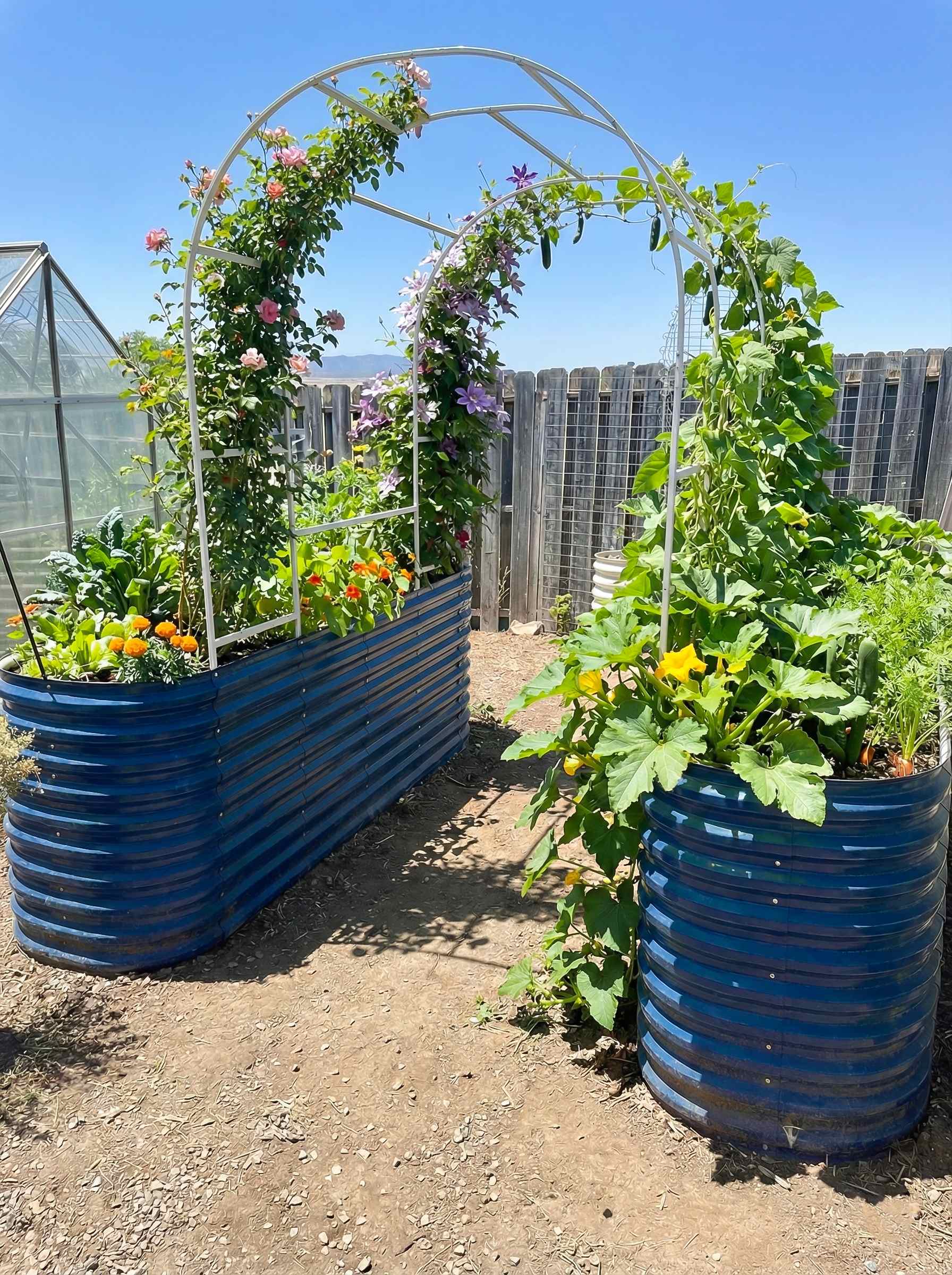
This is why different plants need different spacing recommendations. For example, if cucumbers use a trellis to grow upwards, they can reduce the horizontal footprint, allowing them to spread on the ground, which requires greater spacing. VEGEGA offers wall trellises and arched trellises, which are specially designed for climbing plants with different needs.
Maximize Harvest Without Overcrowding Your Raised Bed
Healthy plants need space to develop root systems and plant canopies. When each plant has enough room to grow, it can absorb sunlight and nutrients more effectively and ultimately produce a higher-quality harvest.
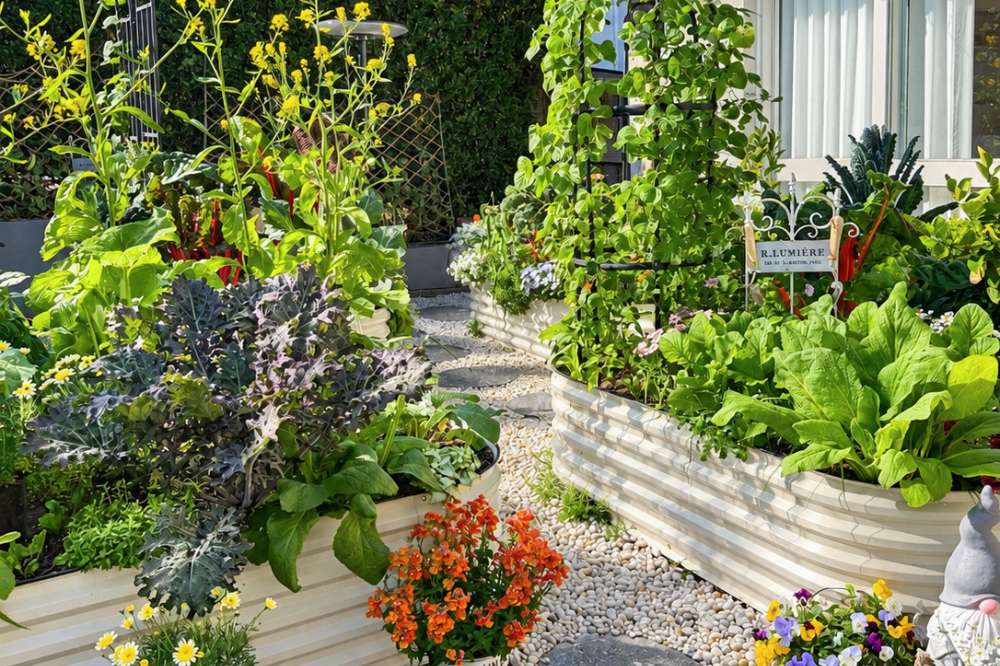
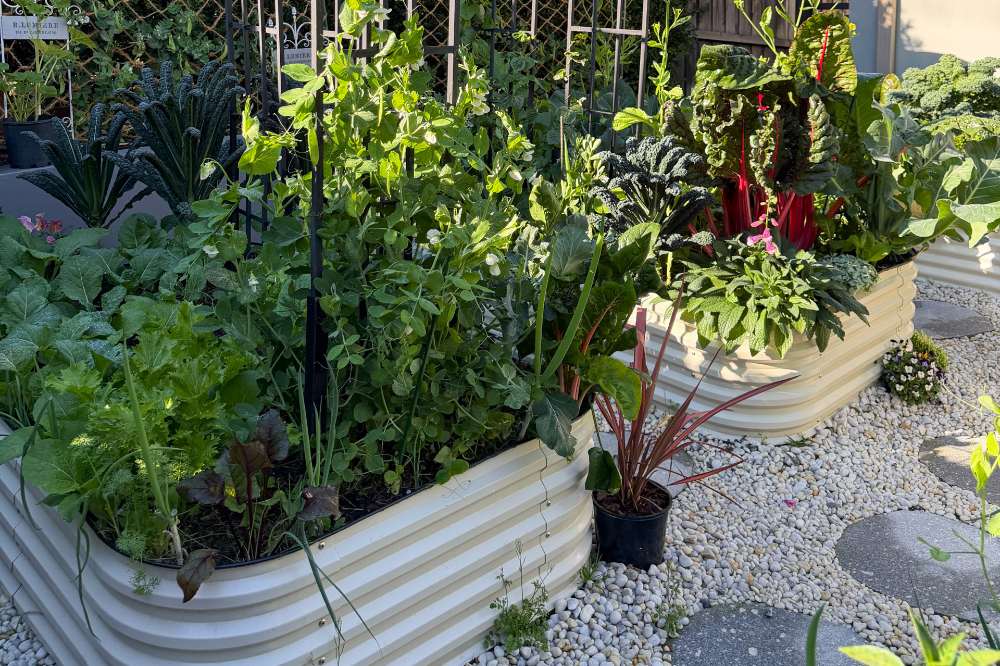
The advantage of raised beds is that you can improve space utilization through a more scientific layout, such as:
- Plant tall crops on the north side to avoid blocking short plants.
- Use a trellis to support climbing plants such as cucumbers and beans.
- Grow small crops such as lettuce and vanilla on the edges.
- Different areas can be arranged according to the mature size of the plant.
In other words, a good raised bed plant spacing is not simply to reduce the number of plants, but to find a balance between “plant health” and “space utilization” in a limited space.
How Much Space Do Common Vegetables Need?

The needs of different vegetables for growth space vary greatly. The factors that affect plant spacing include not only the final size of the plant, but also how it grows, the range of the root system, and whether it is planted with brackets.
For example, cucumbers grown with a trellis, which are also vine-like plants, can grow upwards and reduce the horizontal footprint, while unsupported cucumbers require more ground space. Similarly, tomatoes will have different needs due to different varieties. The space requirements of determinate and indeterminate tomatoes are not the same.
The following spacing recommendations for common vegetables can help you plan the raised bed planting layout:
| Vegetable | Recommended Plant Spacing | Growing Tips |
|---|---|---|
| Tomato | 18–24 inches | Larger varieties need more space; use cages or stakes |
| Cucumber | 12–24 inches | Trellising helps save space |
| Pepper | 12–18 inches | Needs enough airflow around leaves |
| Lettuce | 6–12 inches | Can be planted closer for baby leaves |
| Carrot | 2–4 inches | Requires loose soil for root growth |
| Strawberry | 12–18 inches | Allow room for runners to spread |
| Basil | 8–12 inches | Regular harvesting encourages bushier growth |
| Beans | 4–8 inches | Climbing varieties benefit from vertical support |
Tomatoes are one of the most popular crops in a raised bed garden. Generally speaking, it is recommended to maintain a distance of 18-24 inches between tomato plants. If you are planting large indeterminate tomatoes or want to get better air circulation, you can increase the spacing appropriately. The reason why tomatoes need more space is that their roots need to absorb a lot of water and nutrients, their branches and leaves will continue to expand with the season, and the fruit growth requires sufficient light. Many starters will make a common mistake. When they first planted tomato seedlings in the spring, they felt that there was plenty of space, so they planted the tomatoes closer. But in summer, after the plants grow rapidly, the leaves will quickly fill the entire raised bed. Over-dense planting will increase the difficulty of pruning, also cause the lower leaves to be wet for a long time, and reduce the fruit ripening speed. So if you are using a trellis or tomato cage, it can help tomatoes grow upward and make more effective use of limited space.
In traditional planting methods, cucumber vines will spread around, so a larger horizontal space is required. But in raised beds, many gardeners use a trellis to make cucumbers climb up. When planting with brackets, cucumbers are usually kept about 12-18 inches apart. If you let the vines spread on the ground, it may take 18-24 inches or more of space. Vertical planting can not only save the raised bed area but also make cucumber fruits easier to find and pick, and the air circulation between the leaves is better. For raised beds with limited space, such as 2×8 raised beds, a trellis is an effective way to improve planting efficiency.
Although chili plants do not occupy a lot of space like tomatoes, if they are planted too densely, they can easily affect growth. Generally, pepper plant spacing is recommended to be 12-18 inches. Peppers need proper space to form a healthy leaf crown. If the distance between the peppers is too close, the branches and leaves can easily block each other after maturity, which may affect flower development and fruit yield. In raised beds, peppers are usually suitable for arrangement in the middle area, and they are planted with lower crops such as lettuce and vanilla to make full use of the space of different heights.
Compared with tomatoes and cucumbers, lettuce and carrots are more suitable crops for intensive cultivation. Lettuce usually needs about 6 inches for baby lettuce and 8-12 inches for mature spherical lettuce. Due to the short growing period of lettuce and the small size of the plants, it is suitable for planting at the edge of the raised bed or to fill the gap between large crops. Carrots usually only need a spacing of 2-4 inches. However, it should be noted that although the above-ground part of the carrot is small, the underground roots need space to expand. Therefore, the softness of the soil is as important as thinning. For small-area raised beds, carrots and lettuce are excellent choices to improve space utilization.
Understanding the mature size of each plant is the first step in planning a raised bed. But how many plants can my raised bed grow? This is also an important factor in determining the size selection and layout planning of a raised bed.
How Many Plants Can Fit in a Raised Bed?

To know how many plants can be planted in a raised bed, several factors need to be considered in advance: the size of the plant after it matures; the space required by the root system; whether a trellis is used; whether air circulation needs to be maintained between plants; and whether different crops are reasonably matched. A reasonable raised bed planting layout should maximize space utilization while ensuring that each plant has enough room to grow.
How Many Plants Fit in a 2×8 Raised Bed?
2×8 raised beds belong to a narrow but longer planting space, which is very suitable for leafy vegetables such as herbs, lettuce, carrots, strawberries, and small vegetables. They are used with a trellis to grow vine crops. Since the width is only 2 feet, gardeners can easily reach the plants from both sides, so there is no need to reserve additional walkways for maintenance.
For example, a 2×8 raised bed can be planted according to the small crops grown:
- Medium lettuce: about 20-30 plants.
- Medium-sized carrots: about 50 or more.
- Imported strawberries: about 8-12 plants.
If you grow large crops such as tomatoes and peppers, you need to reduce the quantity. For example:
- Green tomatoes: about 4-6 plants (depending on the variety and support method).
- Black pepper: about 10-12 plants.
If a trellis is used, climbing crops such as cucumbers and beans can be planted behind the narrower raised bed, making use of the vertical space and leaving the bottom area for other vegetables.
How Many Plants Fit in a 4×8 Raised Bed?
A 4×8 raised bed can usually grow more types of vegetables, such as tomatoes, cucumbers, peppers, lettuce, carrots, and herbs.
A common layout method is to divide the area according to the height of the plant:
Back area for tall and vertical crops. Arrange tall plants on the north side or the less-backlit side, such as tomatoes, cucumbers, and beans. Match with trellis or brackets to allow plants to grow upward and avoid blocking other crops. For example, you can have 6-8 tomatoes and 6-10 cucumbers (using brackets).
Middle area for medium-sized vegetables. The middle area is suitable for chili, eggplant, and basil. For example, 12-16 peppers; 10-15 herbs. These plants will not expand as quickly as tomatoes and can fill the space in the middle of the raised bed.
Edge area for compact crops. The edge of the raised bed is suitable for growing lettuce, carrots, and strawberries. These plants are low in height, do not easily affect other crops, and are easy to pick at the same time. For example: 20-30 lettuce plants, more than 50 carrots, 15-20 strawberries.
Common Plant Spacing Mistakes to Avoid

Planting Too Closely Without Considering Mature Size
Crowded plants often compete for sunlight, water, and nutrients, while also creating poor airflow around leaves. Before planting, consider the mature size of each crop rather than its current appearance. A small tomato seedling may eventually need much more room than lettuce or carrots.
Using Traditional Garden Spacing in Raised Beds
Raised beds allow more efficient use of space because plants can be arranged in blocks instead of traditional rows. However, this does not mean every crop should be planted as closely as possible. Small crops like lettuce and carrots can grow well in tighter spaces, while large plants such as tomatoes and cucumbers still need enough room for healthy growth.
Ignoring Plant Height and Sunlight Direction
Tall crops like tomatoes, cucumbers, and beans can shade shorter plants if placed incorrectly. A good raised bed planting layout usually places taller plants where they won’t block sunlight from smaller crops. Planning for mature height and growth habits helps every plant receive enough light throughout the growing season.
Conclusion
Planning your plant spacing is one of the most important steps to creating a productive raised bed garden. The right distance between plants helps vegetables access enough sunlight, water, and nutrients while reducing competition and disease risks.
A successful raised bed is not about fitting in the most plants possible — it is about creating the right environment for each plant to thrive. With thoughtful planning and the right raised bed layout, even a compact garden can provide fresh harvests throughout the season.