How to Grow Climbing Vegetables Vertically in a Raised Bed
Last Updated: September 24, 2026 by Vegega Team
For vertical vegetable gardening in a raised bed, the key is to select climbing vegetables suited to vertical growth and choose an appropriate trellis based on the plant's growth habits and the weight of the fruit. Pole beans, peas, cucumbers, indeterminate tomatoes, Malabar spinach, etc., can all use vertical space, thereby reducing ground occupation, improving air circulation, and making harvesting more convenient.
- Why Grow Climbing Vegetables Vertically in a Raised Bed?
- Which Climbing Vegetables Grow Well on a Trellis?
- How to Choose the Right Trellis for Climbing Vegetables
- How to Grow Climbing Vegetables Vertically in a Raised Bed
If you have planned metal raised beds but want to increase the planting space, you do not have to buy more raised beds. The upper floor is the only usable space for beans, cucumbers, peas, and other vining vegetables.
Directing these vegetables from the raised beds to a trellis is not simply making the plants stand up. Different vegetables have different climbing methods, vine lengths, and fruit weights, so it is necessary to choose the support structure based on the plant, and then determine its position in the raised bed. In this way, vertical gardening can truly become an effective planting method, rather than adding an additional garden structure.
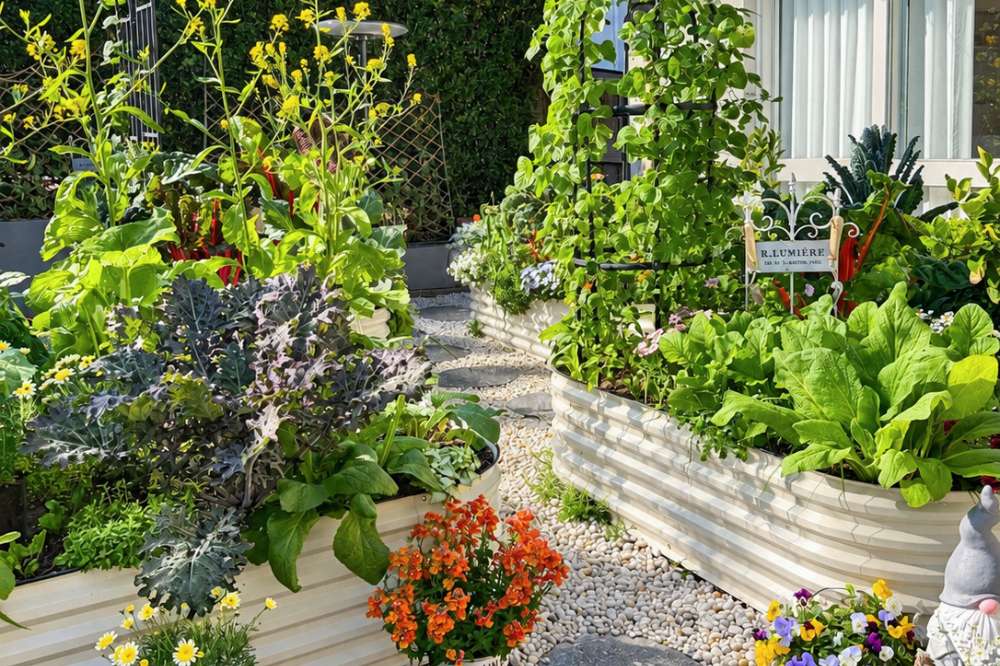
This is especially true for small-space gardens. A raised bed can accommodate low-lying leafy greens, herbs, and upward-growing climbing vegetables at the same time, allowing the limited acreage to form different vertical levels, and it is easier to maintain a clear space during subsequent management and harvesting.
Why Grow Climbing Vegetables Vertically in a Raised Bed?

The advantage of a raised bed is that the planting area is concentrated and the soil is easy to manage, but its area is also limited. If cucumber vines, pole beans, or peas are allowed to spread to the ground, they will quickly occupy the space where other crops can be grown. After directing such vegetables to a trellis, the plants mainly use the upward space, and the ground can be reserved for crops that are more suitable for low growth. This is also the most direct value of vertical vegetable gardening in small vegetable gardens.
This way of space allocation can also allow the same raised bed to bear different planting levels. For example, taller vining vegetables can grow upward along a trellis, while lettuce, herbs, or other low crops can still be arranged around and in front of them. The point is not to stuff as many plants as possible in a limited area but to allow vegetables with different growth habits to use different spaces, thereby reducing competition with each other.
Vertical growth also changes the distance between vegetables and the soil. After the leaves and fruits of crops such as cucumbers and beans leave the ground, they are not as likely to come into direct contact with moist soil, and the fruits are easier to keep clean. At the same time, after the plants are spread from the ground to an upward distribution, better airflow between the leaves is usually obtained, which is especially beneficial for vining crops with lush branches and leaves that require continuous ventilation.
Another practical advantage is management and harvesting. When vines grow along a clear support structure, the branches, leaves, flowers, and fruits of the plants are easier to observe. Vertically grown cucumbers or beans are easier to access than mature fruits found in a large area of vines spreading on the ground, making it more convenient to identify branches that need guidance, fixing, or timely pruning.
Therefore, vertical gardening is not just about making the raised bed look more layered. For climbing vegetables, a trellis actually redistributes the space occupied by plants: the root system is still in the raised bed, while the vines, leaves, and fruits extend upward. When this spatial relationship is reasonably designed, a vegetable bed with a limited area can also have more effective planting areas.
Which Climbing Vegetables Grow Well on a Trellis?

Not all vegetables are suitable for vertical growing through a trellis. Truly suitable climbing vegetables usually have longer vines or flexible stems and can rely on tendrils, twining stems, or artificial guidance to extend upward during growth. When choosing a plant, instead of simply pursuing the number of species, it is better to observe how it grows and how much support space it needs after maturity.
Pole Beans and Peas
Pole beans are one of the most typical climbing vegetables. Unlike bush beans, which occupy more ground space, pole beans will continue to stretch upward and can climb along a trellis. Their growth direction is relatively clear, so they are particularly suitable for placement on the back or end of the raised bed, allowing the vines to develop upwards instead of spreading out around.
Peas are also suitable for planting with a trellis, especially snow peas and other varieties with climbing habits. They are more suitable for cool growing environments, so they can be the choice in early-season or late-season vertical gardens. For small-space gardening, the common advantage of these two types of vegetables is that the main growth space of the plants is transferred to the top, and the soil surface of the raised bed can still be left to other low-growing crops.
Cucumbers and Vining Tomatoes
Cucumbers are common vegetables that grow on a trellis. The vines will continue to extend outward, and if there is no support, they can easily occupy a lot of ground space around the raised bed. After directing them to the trellis, the vines can spread along the support structure, and mature cucumbers are easier to locate and harvest.
Tomatoes need to choose varieties more carefully. The main ones suitable for vertical growing are indeterminate tomatoes, because these kinds of tomatoes will continue to grow upward and need stable support to control the position of the branches and fruits. Guiding them vertically can prevent the branches, leaves, and fruits from being close to the ground for a long time, and it also makes it easier to bind, observe, and harvest in the later stage.
Malabar Spinach, Cucamelons, and Luffa
Malabar spinach grows faster in warm areas, produces soft vines, and can extend upward along the support structure. It is different from the traditional way of growing spinach, so it is more suitable for warm-season vegetable gardens that need to use vertical space.
Cucamelons are small climbing crops with fine vines. Their tendrils can grasp the trellis, causing the plants to gradually expand upward, and the small fruits hang between the vines, making it easier to observe maturity than spreading on the ground.
Luffa has a stronger climbing ability, and vines can form a longer growth range, so it requires more vertical space than small climbing crops.
Squash and Other Heavy Vining Crops
Squash can take advantage of vertical space, but not all squashes can be simply regarded as ordinary trellis crops. Some vining squash varieties have long vines, and the weight of mature fruits will also place higher requirements on the support structure. Therefore, if you want squash to grow upwards, you should prioritize smaller varieties suitable for vertical cultivation and consider the load-bearing capacity of the fruits as they mature.
For heavier fruits, just letting the vines climb does not mean that the support is sufficient. If necessaryyou can use additional slings or similar supports to distribute the weight of the fruit across the structure, preventing the mature fruit's weight from being concentrated on the vine or a single connection point.
Chayote is also a climbing vegetable that requires strong vertical space, which is more suitable for areas with warm and longer growing seasons. It can form very vigorous vines, so sufficient climbing space should be reserved before planting, rather than arranging it as an ordinary small vegetable.
How to Choose the Right Trellis for Climbing Vegetables


Arch Trellis
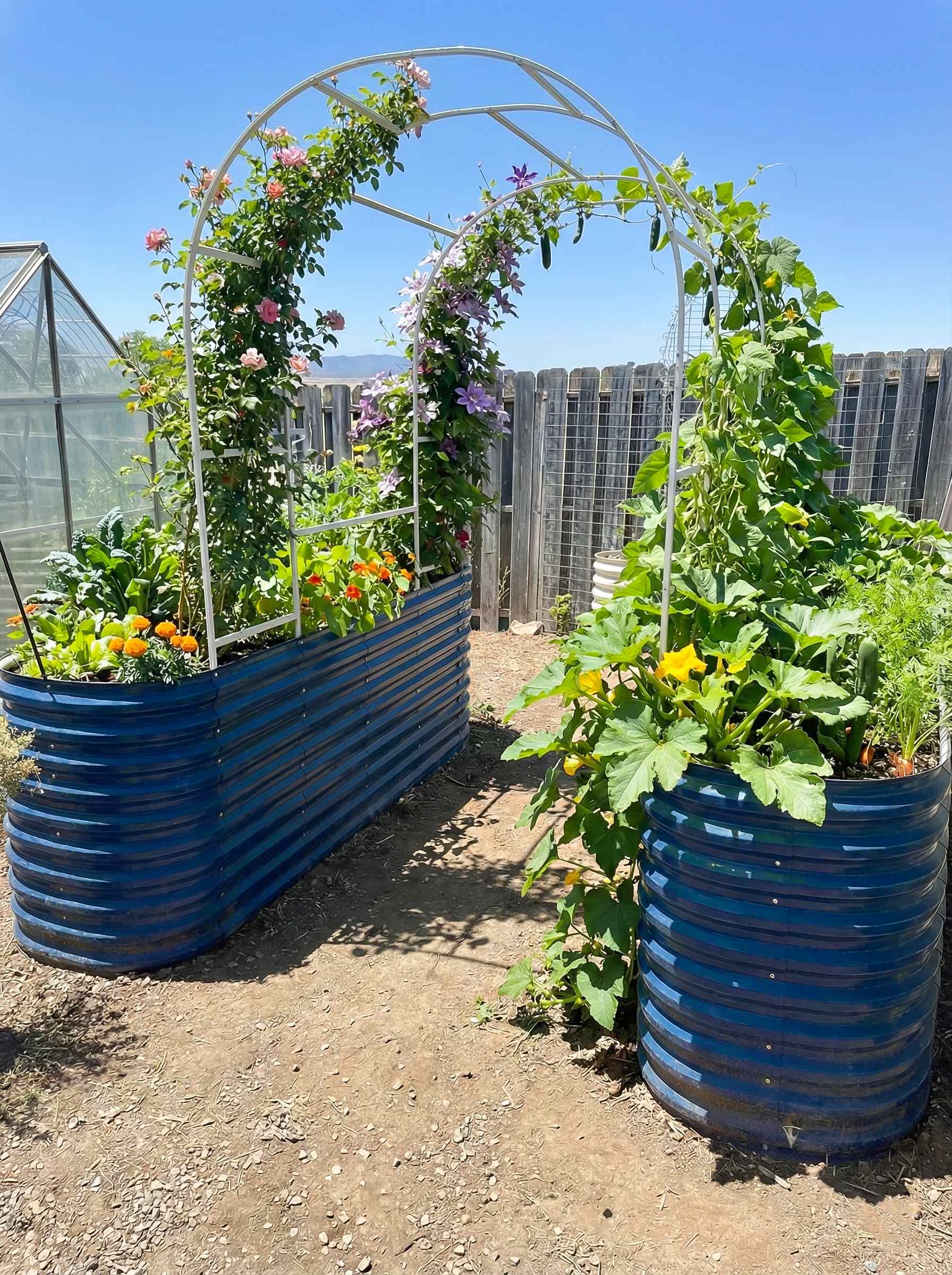
An arch trellis is suitable for vining vegetables that require a large vertical growth space and extend to both sides or above at the same time. It needs to be installed between two metal raised beds for use, allowing the vines to gradually grow upward along the arc support and then extend to the other side.
This structure is especially suitable for crops with relatively soft vines such as cucumbers, pole beans, and peas that can continue to climb upwards. As the plants grow taller, the vines can cover different locations of the trellis, rather than being concentrated in a certain corner of the raised bed. For small-space vertical gardening, this design can also transform the growth area originally occupied horizontally into a three-dimensional space.
If there is a channel between the raised beds themselves, an arch trellis can also assume the role of spatial connection at the same time. The green vault formed after the plants mature not only provides a continuous climbing surface but also makes the garden layout more three-dimensional. For planters who want to take into account both planting function and garden appearance, VEGEGA Arch Trellis belongs to this application scenario.
Wall Trellis
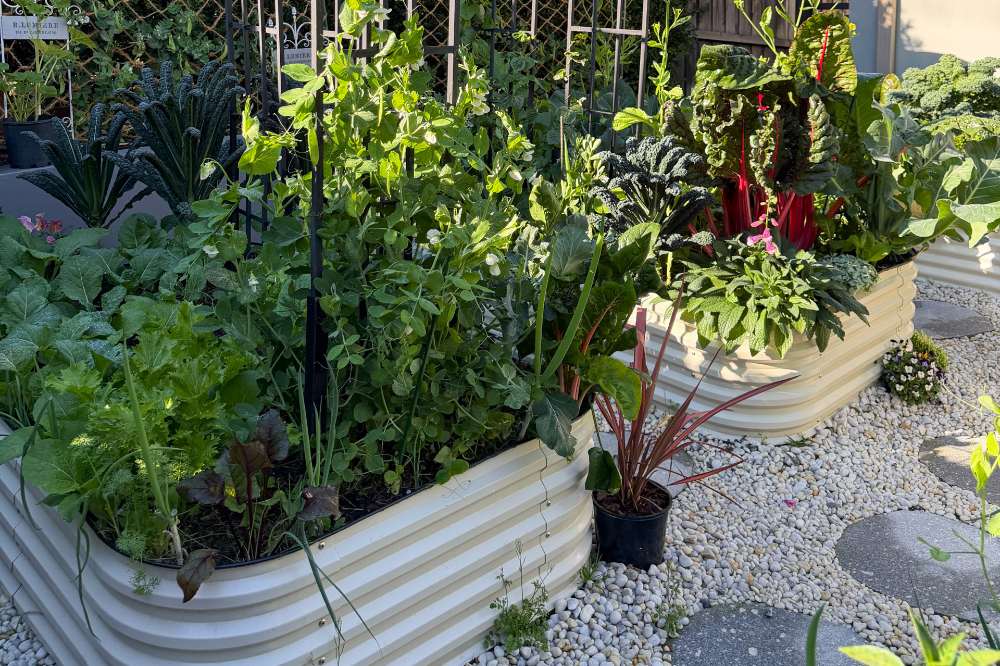
If the raised bed is close to a wall, fence, or other fixed vertical surface, a wall trellis is often more suitable. Its advantage is not to provide more horizontal space but to allow plants to directly use the existing vertical area, thereby minimizing additional ground space.
Climbing beans, peas, cucumbers, and other vining plants that require continuous upward guidance can all grow along the support structure of this plane. For raised beds with limited area, this layout is particularly valuable because the trellis does not need to occupy the center of the raised bed, and plants can be concentrated on one side of the bed to develop upwards.
Therefore, if your goal is to make a vertical garden for small spaces as compact as possible, a wall trellis can be a direct choice. VEGEGA Wall Trellis can be installed on adapted metal raised beds, allowing climbing plants to grow along a fixed vertical plane, and it is easier to combine with a vegetable garden layout against a wall or fence.
Match the Trellis to the Plant
The key to choosing a trellis is not which structure is "best," but which structure is more compatible with the way plants grow. If the plant mainly climbs upward and the planting space is close to the wall or the side of the raised bed, a wall trellis can help it focus on the vertical space. If you want the vines to span the two planting areas and form a larger climbing surface, an arch trellis will provide a more continuous growth path.
At the same time, the weight of the fruit needs to be taken into account. The pressure of beans and peas on the support structure is usually different from that of large squashes, so a trellis cannot be selected only according to the height of the plant. Vine length determines the space, while plant and fruit weight determine the support.
How to Grow Climbing Vegetables Vertically in a Raised Bed

After choosing climbing vegetables and a trellis, the actual planting is not complicated, but a few details will directly affect the growth direction of the vines in the later stages. It is best to install the trellis before sowing or transplanting so that the location of the plant can be determined in advance and the disturbance of the established root system can be avoided when the structure is installed later.
Planting vining crops near the roots of the trellis allows the vines to come into contact with the support structure from an early stage. After the seedlings begin to elongate, the newly grown vines can be gently directed to the trellis regularly, allowing them to gradually form a stable climbing direction, rather than waiting for the vines to be spread on the surrounding plants before finishing.
Vertical planting does not mean that the plant spacing can be ignored. The root system of each plant still needs enough space while also considering the range of mature leaves and the shade produced by the trellis. Especially for vigorous cucumbers, tomatoes, or squash, sufficient horizontal space should be reserved in advance to avoid overcrowding in the later stage.
For squash or other vining crops that produce heavier fruits, it is also necessary to check the support as the fruits gradually gain weight. Add additional fruit support if necessary so that the weight will not be concentrated on the vines or a single support point. In this way, vertical gardening can continue steadily from the early stage of planting to harvest.
Conclusion
Vertical gardening in raised beds is not just adding a trellis but replanning how plants use the limited planting space. Choose climbing vegetables with climbing or vine habits, then match the appropriate trellis according to the growth method of the plant and the weight of the fruit, and finally guide the vines upward over time during the growth period so that the plants that were originally easy to spread around can be transformed into a more orderly vertical growth.
For small-space gardens, this method is particularly suitable. Pole beans, peas, cucumbers, indeterminate tomatoes, and other vining vegetables suitable for vertical planting can all make full use of the space above without expanding the raised bed footprint, making the planting layout of the raised garden bed more efficient and more convenient for later management and harvesting.